Apple's new MacBook Pro costs up to $15,000

Tech Desk
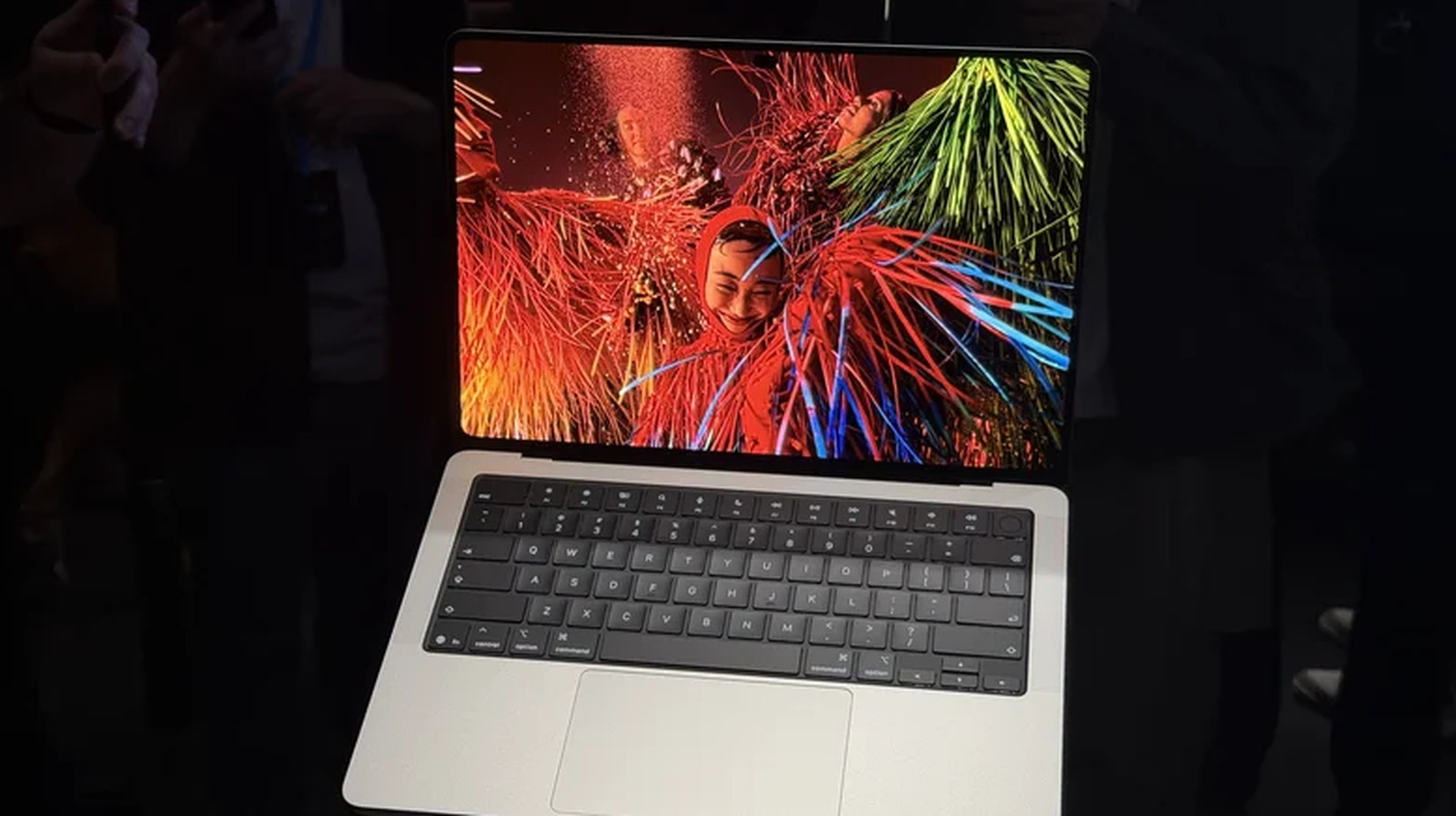
Apple unveiled its redesigned MacBook Pro, featuring an OLED touchscreen, on October 28, with the device becoming available shortly thereafter. Those seeking a fully equipped 16-inch MacBook Pro with the new PROLED XDR Display must be prepared to pay nearly $15,000.
Advertisement
The laptop is listed at $14,549 on the Apple online store. However, the new touchscreen accounts for very little of this cost. A massive 16TB SSD represents $7,000 of the total price, while upgrading from 48GB to 128GB of unified memory adds another $2,000. Combined, storage and memory make up approximately 62 percent of the final price.
When configured to match the top specifications of the non-touch 16-inch MacBook Pro, which remains available, the OLED version costs $10,549. This is only $400 more than that model’s $10,149 price tag.
The top configuration is built using the 16-inch model’s M5 Max chip, featuring an 18-core CPU and 40-core GPU, starting with 48GB of memory and a 2TB SSD. If you subtract the screen, RAM, and storage upgrades, the $14,549 machine works out to $5,399. This is already $2,000 more than the $3,399 entry-level 16-inch model equipped with an M5 Pro.
Apple charges an additional $1,000 to move from 2TB to 4TB, $3,000 to reach 8TB, and $7,000 for 16TB. This equates to $500 more per terabyte, with no discount provided for bulk purchases.
Advertisement
The 16TB storage option is a first for the MacBook Pro, as the M5 Max models released by Apple in March topped out at 8TB. Memory remains restricted, as only the 40-core M5 Max can be configured with 128GB of RAM, while the 32-core version is limited to 36GB and the M5 Pro caps at 64GB. To maximize memory, users must purchase the most expensive chip.
Nano-texture glass, which is etched directly into the cover to reduce glare, is the most affordable upgrade at $150. The 14-inch model has a slightly lower maximum price of $14,249, and the cheapest way to obtain 16TB of storage is through a 14-inch M5 Max with 36GB of memory for $11,499.
In March 2026, a maxed-out 16-inch MacBook Pro with an M5 Max, 40-core GPU, 128GB of memory, 8TB of storage, and nano-texture glass cost $7,349. In late June, Apple increased prices across its Mac and iPad lineups, blaming the rapid expansion of AI data centers for creating an extraordinary surge in demand for memory and storage. By the end of June, that same configuration cost $10,149, representing a $2,800 increase for hardware that had not changed.
The base 14-inch MacBook Pro also rose from $1,699 to $1,999. Analyst firm Counterpoint reported that smartphone DRAM prices increased 50 percent and NAND flash storage prices rose more than 90 percent quarter-over-quarter during the first three months of 2026. Apple informed customers that it had never seen component prices increase that much or that quickly, noting that it had absorbed rising costs for as long as possible.
Advertisement
Compared to the $10,149 top price of the non-touch model, the redesign accounts for $400 of the new model's cost, while the jump from 8TB to 16TB adds another $4,000. Almost all that extra cash is going toward NAND flash, the component that has seen the fastest price rises according to Counterpoint's figures.
The PROLED XDR Display on the larger model is a 16.3-inch tandem OLED panel that Apple says sustains 1,000 nits and reaches a peak of 2,000 nits. It covers the P3 and Adobe RGB color gamuts, refreshes at up to 120Hz, responds to touch, and features a Dynamic Island. In their hands-on, the reviewers remarked how Apple's first touchscreen model felt familiar yet improved, retaining the same keyboard, trackpad, and ports, and found the touchscreen to be the least interesting part.
The M5 Max chip pairs an 18-core CPU and 40-core GPU with 614GB/s of memory bandwidth. According to Apple, this is sufficient to run LLMs locally on the laptop, and it is where 128GB of RAM is worth the extra cash, as a local model must fit in memory and Apple's GPU draws from the same pool as the CPU. The 16-inch M5 Max model weighs 4.1 pounds, is 0.63 inches thick, and provides up to 22 hours of streaming with its 100Wh battery.
Apple is targeting this $15,000 machine at professionals such as filmmakers, 3D artists, photographers, and developers. However, because every extra terabyte adds $500 to the price, most workloads would be better served by a 2TB or 4TB model alongside an external Thunderbolt 5 drive. For those running local LLMs, it is easier to justify the cost of the 128GB memory option, though the 16TB SSD still accounts for nearly half the price of the configuration.