


ESA study reveals stadium-sized crater on asteroid from NASA mission

Tech Desk
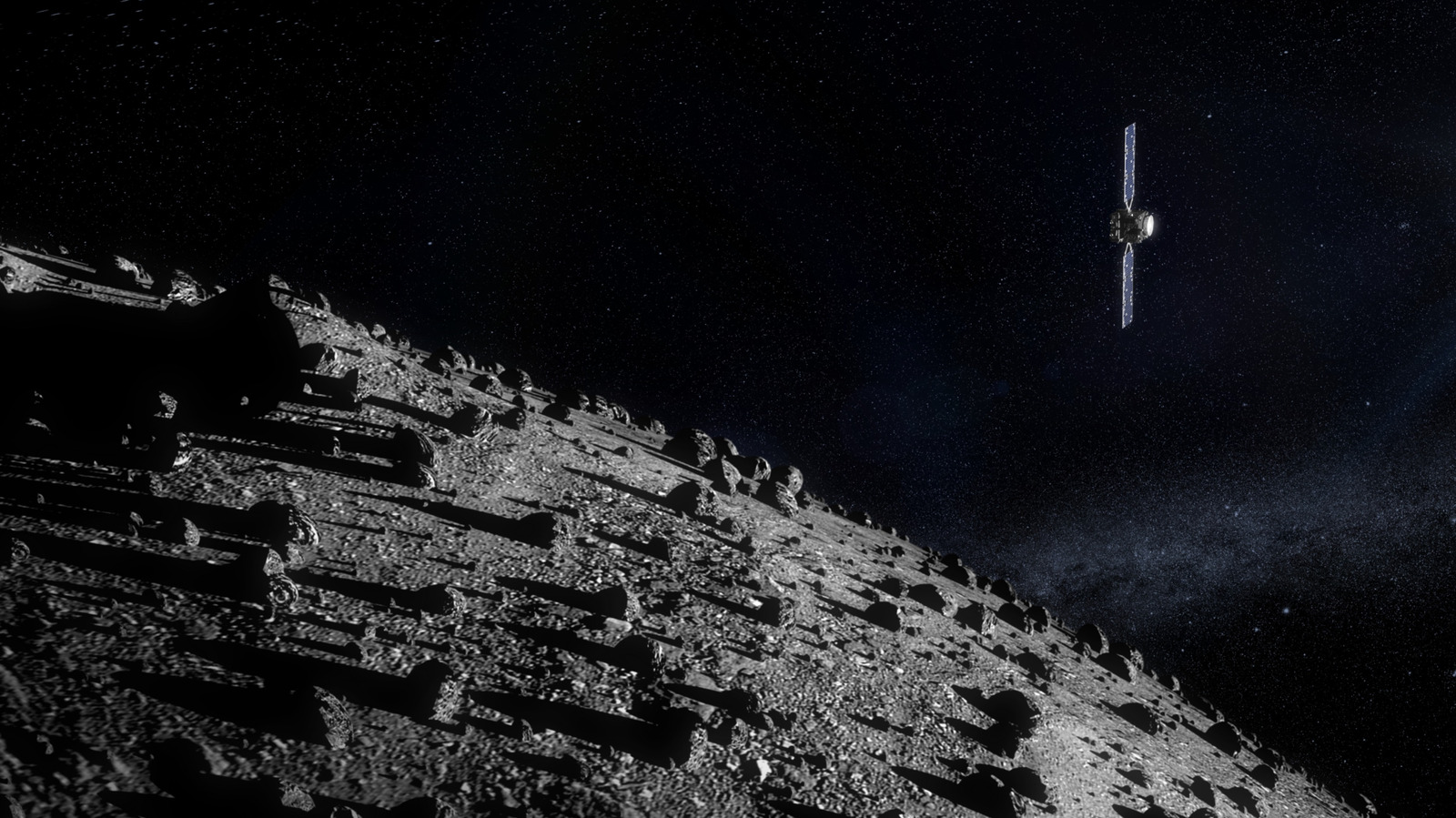
New imagery from the European Space Agency's (ESA) Hera spacecraft has confirmed that the 2022 NASA Double Asteroid Redirection Test (DART) mission left a crater the size of a sports stadium on the asteroid Dimorphos. The impact, which was designed to test planetary defence capabilities by altering the orbits of Dimorphos and its parent asteroid Didymos, created a crater stretching across the asteroid's entire width.
Advertisement
Patrick Michel, Director of Research at the National Centre for Scientific Research (CNRS) and principal investigator for Hera, stated that the collision did not disrupt the fields of boulders located across the remainder of the asteroid's surface. The ESA reported that the impact caused Dimorphos to begin tumbling in its new orbit and noted that both asteroids are now surrounded by hundreds of orbiting boulders.
Data for these findings were collected by the Hera spacecraft using its monochrome Asteroid Framing Camera, the multi-spectral Hyperscout H, and a JAXA-developed Thermal Infrared Imager. These instruments captured the observations while positioned between 25km and 30km from the asteroids.
Hera mission manager Ian Carnelli remarked, "NASA's DART mission demonstrated that we can change an asteroid's orbit." He added, "Hera is now revealing what happened to the asteroid itself. By combining these two missions, humanity is taking a decisive step towards making asteroid deflection a reliable tool for protecting our planet."
Future operations include moving the Hera spacecraft closer to the asteroids in December to obtain higher-resolution imagery. In January, the mission intends to deploy shoebox-sized CubeSats to gather further information. A Luxembourg-led team has developed the Juventas CubeSat to use radar to examine the asteroid's interior before landing, while an Italian-led team will use the Milani CubeSat to study surrounding materials and asteroid dust.